
Arrest Records in Jefferson County
An arrest record is made by law enforcement, not the court. In Jefferson County, the Sheriff's Office books people into the county jail, and city police such as Beaumont PD and Port Arthur PD make arrests that often land in the same jail. The record of that booking lists the name, the charges, the bond, the arresting agency, and a warrant or case number. The Sheriff posts current bookings and a daily arrest log so the public can find recent Jefferson County arrest records.
Keep the difference clear. An arrest record marks the moment of custody. A criminal court record begins when prosecutors file charges. A conviction record is the outcome after a plea or trial. This page leads with arrest records and the jail roster. For full case history and dispositions, the Jefferson County court records page covers the clerk indexes and the court portal.
How to Search Jefferson County Arrest Records
The Sheriff's Office is the first stop. Its inmate search lists current bookings with a type-to-search box and paginated cards. A separate daily arrests PDF logs recent intakes. For older criminal history, the Texas Department of Public Safety runs the statewide system. The Sheriff inmate search, shown below, is linked from the Sheriff's inmate search page.
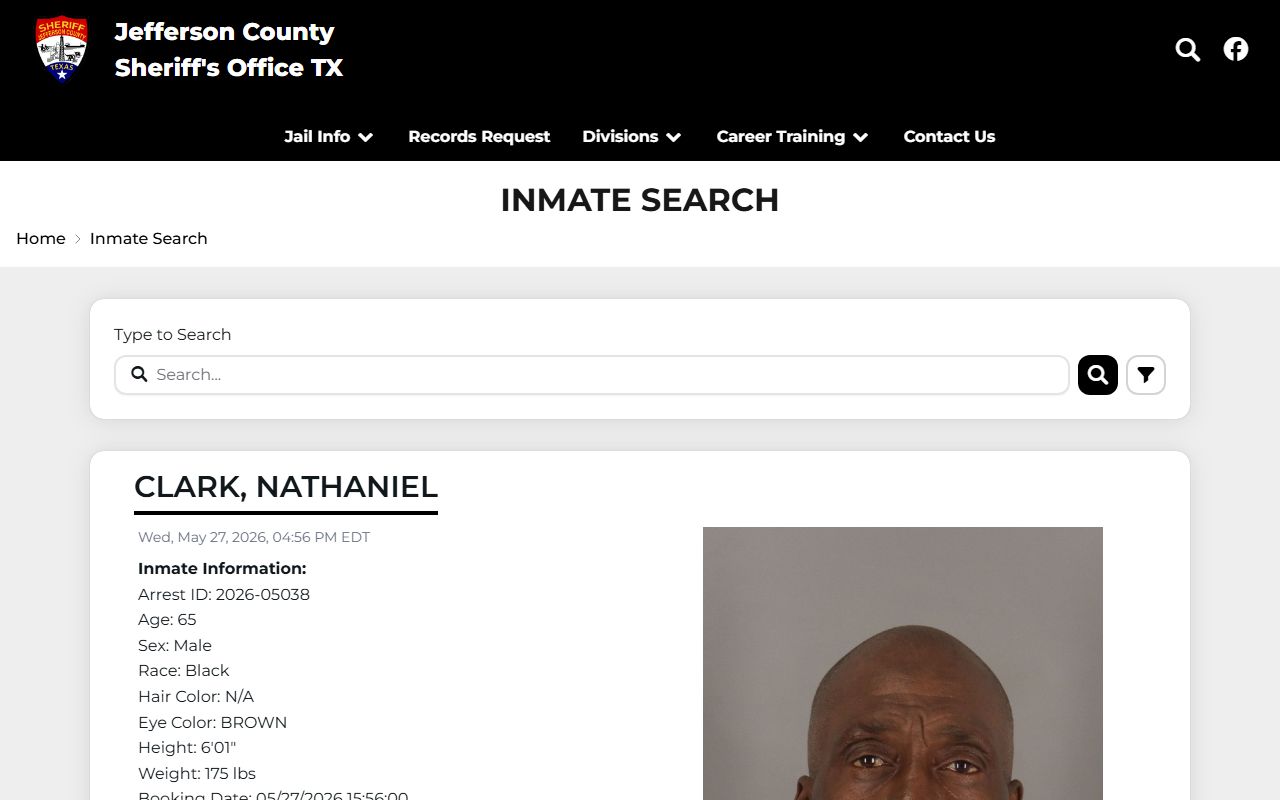
The roster shows only current custody, not a person's full history. Use these steps to find a recent Jefferson County arrest record.
- Open the Sheriff's inmate search and type a last name into the search box.
- Scan the inmate cards, then click a name to open the booking detail.
- Check the daily arrests PDF for intakes that may not show on the roster yet.
- For older charges, run a statewide criminal history search through Texas DPS.
Roster fields include the charge, the degree, the bond amount, the arresting agency, and a warrant or case number such as 25DCCR1541 or 25CCCR2034.
What a Jefferson County Arrest Record Shows
A booking entry on the Sheriff's roster packs several fields into a single line. The current inmates roster lists the name and age, the race and gender, the booking date and time, the charge, the bond, the arresting agency, a warrant or case number, and a degree code. The degree code tells you how serious the charge is, from a first-degree felony down to a Class B misdemeanor. The fields below are what you read in a Jefferson County arrest record.
- Name and age - the booked person, last and first, with age.
- Date and time - when the person was booked into the jail.
- Charge and degree - the offense text plus a code like F1, F2, F3, FS, MA, MB, or UNK.
- Bond amount - the dollar amount set, or blank if none.
- Arrest agency - Sheriff, Beaumont PD, Port Arthur PD, or out of county.
- Warrant number - the case or warrant number, such as 25DCCR1541.
The roster header warns that all data is subject to change and that bond and fees must be paid with exact cash. A details line is posted for questions about a booking, and charges shown at intake can change as a case moves through the courts.
Arrest Records vs. Criminal Court Records
These two records cover different stages. The arrest record is built by the Sheriff or police at booking. The criminal court record is built by the clerk once charges are filed and a case opens. One does not replace the other.
| Arrest Record | Criminal Court Record | |
|---|---|---|
| Source | Sheriff or city police | District Clerk or County Clerk |
| Created When | At booking into the jail | When charges are filed |
| Contents | Booking info, charges, bond, mugshot | Pleadings, motions, disposition, judgment |
Charges vs. Convictions
Being charged is not the same as being found guilty. A charge is an accusation that rests on probable cause. A conviction comes only after a plea or a verdict, judged beyond a reasonable doubt. Many Jefferson County arrest records end in dismissal, acquittal, or reduced charges, so read the disposition before you draw a conclusion.
| Charge | Conviction | |
|---|---|---|
| Stage | Accusation at or after arrest | Plea or verdict of guilt |
| Burden of Proof | Probable cause | Beyond a reasonable doubt |
| Final? | No, the case is still open | Yes, unless appealed |
Sealed vs. Expunged Records
Texas gives two ways to limit a criminal record. Expunction under Code of Criminal Procedure Chapter 55 destroys eligible records, and afterward agencies and clerks generally cannot release them. An order of nondisclosure, often called sealing, only hides certain records from the public while law enforcement keeps limited access. The County Clerk points misdemeanor petitioners to state nondisclosure forms.
| Sealed (Nondisclosure) | Expunged | |
|---|---|---|
| Visibility | Hidden from public release | Destroyed, treated as never existed |
| Law Enforcement | Limited access kept | Very limited or none |
| Texas Law | Government Code Chapter 411 | Code of Criminal Procedure Chapter 55 |
Mugshots and Booking Photos
The Sheriff's inmate cards include booking photos for many current detainees, though some use a placeholder image. A mugshot is part of the booking record, not proof of guilt. The Sheriff's site also features a Most Wanted section that lists outstanding suspects.
Booking photos can come down once a person is released, so a current roster photo is a snapshot in time, not a permanent file. Texas courts have addressed the spread of mugshots through third-party sites, but the official source remains the Sheriff. If you see a photo of a Jefferson County arrest on a non-government site, the official confirmation should still come from the Sheriff or the court file. Use the Sheriff's records request route, by email to records@jeffersoncountytx.gov, for an official copy where one exists.
Daily Arrests vs. Current Custody
Two Sheriff sources answer two different questions. The inmate search shows who is in custody right now. The daily arrests log shows recent bookings, including people who may already be out on bond. A new arrest can appear on the daily log before it shows on the main roster, so checking both gives a fuller picture of recent Jefferson County arrest records.
Neither source is a full criminal history. Once a person bonds out, posts bail, or is released, they drop off the current roster. The booking record still exists, but you confirm it through the court case file or a statewide search rather than the live jail list. For people recently let go, the released inmates page explains how to verify a release.
Statewide Criminal Records Search
County tools show local custody. For a person's broader criminal history, Texas runs the statewide system through the Department of Public Safety. Access and dissemination rules sit in Texas Government Code Chapter 411, which also governs orders of nondisclosure. The County Clerk misdemeanor page, shown below, explains how nondisclosure works and is linked from the County Clerk misdemeanor page.
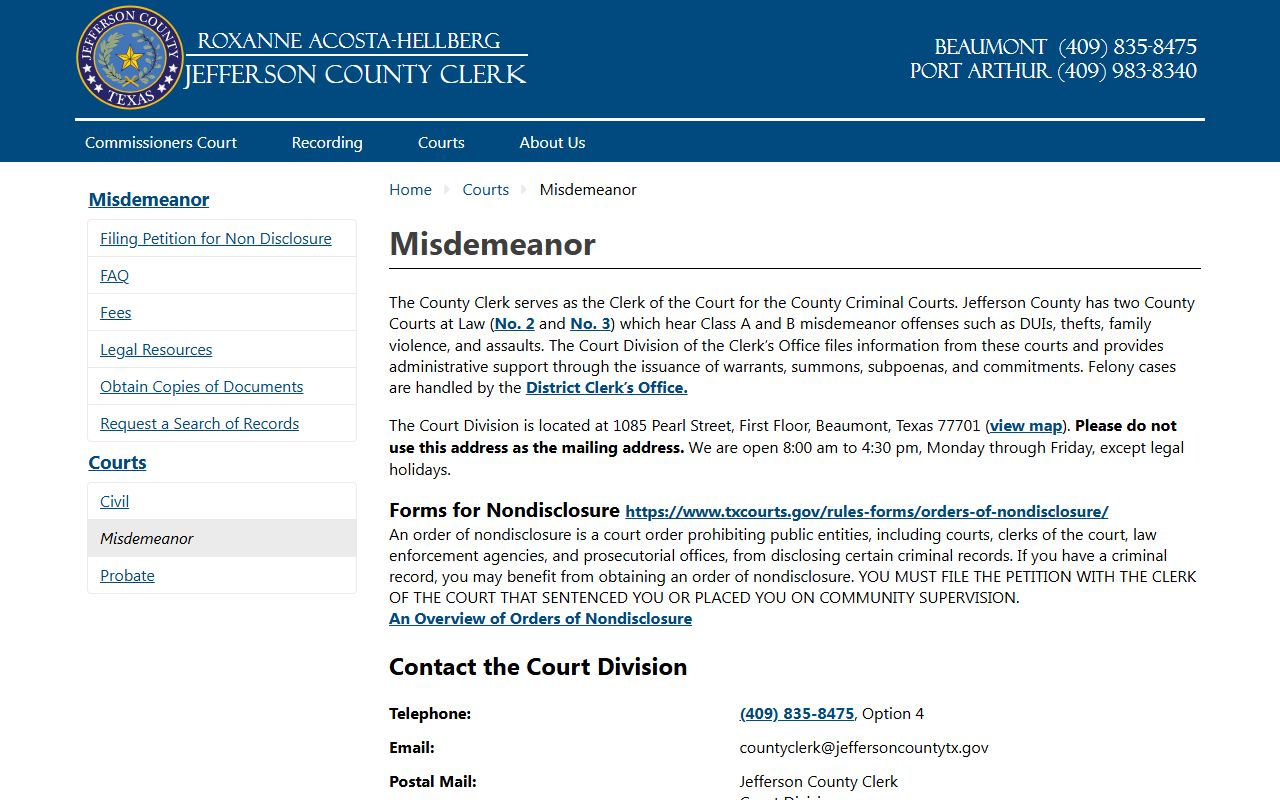
Misdemeanor cases like DUI, theft, family violence, and assault are heard in County Courts at Law Nos. 2 and 3, and those indexes go back to 1951. The County Clerk does not collect misdemeanor fines and fees, even though it serves as clerk of those courts. The Sheriff's Office collects fines and fees where court costs and a fine or jail time have been assessed, while Community Supervision collects fees for people on probation. That split shows up in any in-depth Jefferson County arrest records search that crosses from the booking line into the court process.
Background Check Considerations
A casual name search is not a background check. A true background check for hiring, housing, or credit must follow the federal Fair Credit Reporting Act and use a licensed agency. Jefferson County arrest records found through the Sheriff or DPS are public-service information, not a screening report. Do not use them to make an FCRA-regulated decision.
Important: This site is not a consumer reporting agency under the FCRA, and its arrest information may not be used for employment, housing, credit, or insurance decisions.
Restricted Criminal Records in Jefferson County
Some arrest and criminal records stay closed. Juvenile records fall under Texas Family Code Chapter 58 and are kept out of public indexes. Sealed and expunged records are blocked or destroyed. Active investigations can be withheld under the law enforcement exception to the Public Information Act. Arrest reports may show public front-page facts while investigative detail stays private.
If you need to clear your own record, get legal help. The path depends on the offense, the outcome, and the waiting period. For active orders to arrest, see warrant records, and for current custody see inmate records.