
How to Search Jefferson County Court Records
Jefferson County does not use one single search box. The court records you want depend on which clerk holds the file. The District Clerk keeps district court cases, including felonies, large civil suits, family law, and divorce. The County Clerk keeps official public records, marriage licenses, probate files, and misdemeanor county-criminal cases. Knowing the clerk first saves time. Once you know the clerk, you pick the right tool: the Tyler Enterprise Justice portal, a free yearly index page, or the County Clerk Cloud Search.
Before you start, gather a few details. A full name helps. A case number or warrant number helps more. A rough filing year narrows a long list fast. Sealed, juvenile, and security cases are left out of the public indexes, so a blank result does not always mean a case never existed.
The Tyler Enterprise Justice portal, also called the Odyssey Online Portal, is the county's main case-search system. The screenshot below shows the public landing page linked from the Jefferson County Tyler portal.
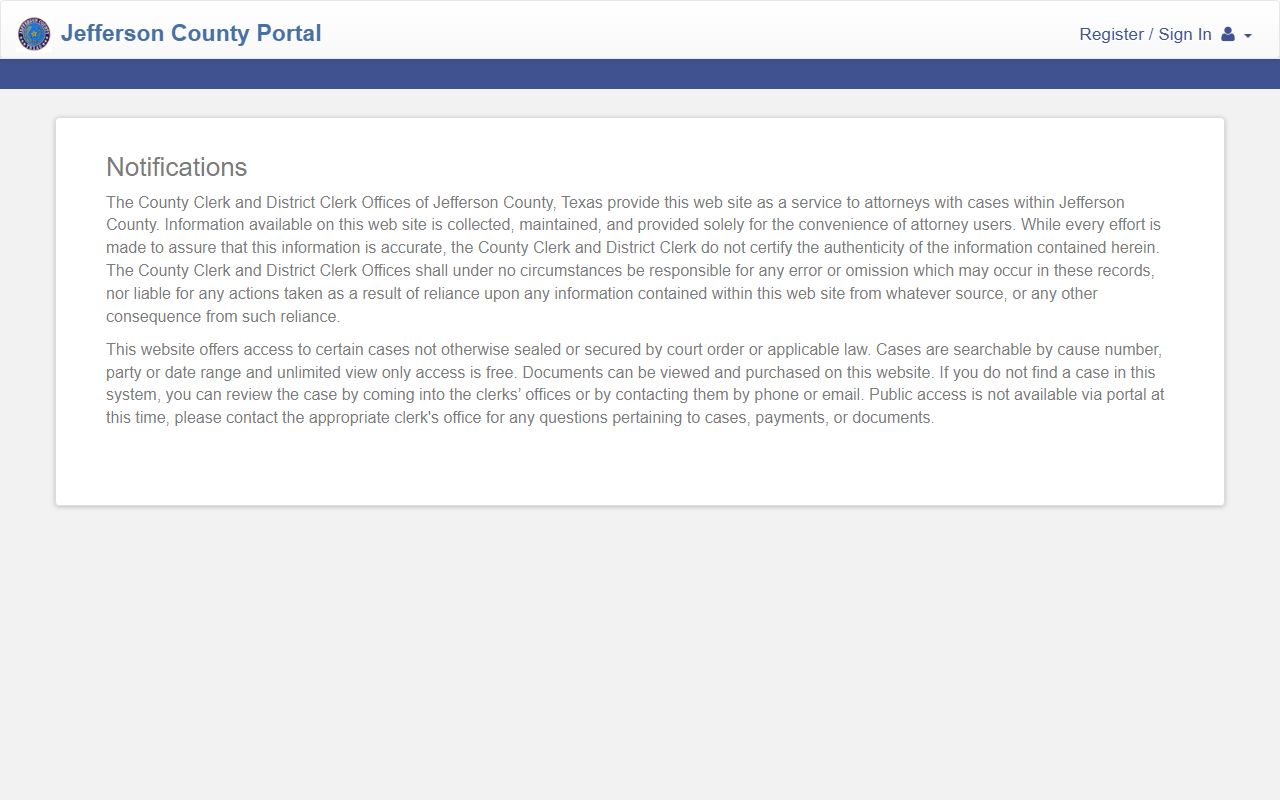
The portal supports case and party searches, and some functions need a registered account. For court case existence without an account, the District Clerk index pages are the quickest free option.
- Decide which clerk holds the case: District Clerk for district court, County Clerk for county court and public records.
- For district cases, open the District Clerk civil, criminal, or family index, pick a year, then use your browser find tool for a name.
- For full district access, open the Tyler Enterprise Justice portal and search by party name or case number.
- For official public records, open the County Clerk Cloud Search, enter a search term, and set a recorded-date range.
- Request a certified copy from the holding clerk if you need a record that counts in court.
The Jefferson County Judicial System
Texas spreads trial work across several court types, and Jefferson County uses most of them. District courts are the main trial courts. They hear felony crimes, large civil cases, family law, and divorce. County Courts at Law handle misdemeanors and smaller civil suits. The County Court, through the County Clerk, hears probate, guardianship, and mental health matters. Justice of the Peace courts take small claims, evictions, and fine-only tickets. City municipal courts handle local ordinance and traffic cases.
Appeals do not stay in the county. Civil and criminal appeals go first to a Texas intermediate court of appeals. From there, civil cases may reach the Supreme Court of Texas, and criminal cases may reach the Texas Court of Criminal Appeals. The Texas Judicial Branch lays out this full structure for every county.
Case flow: Justice Court › County Court › District Court › Court of Appeals
The chart below comes from the Texas Judicial Branch trial courts page, which describes how each trial court level fits together.
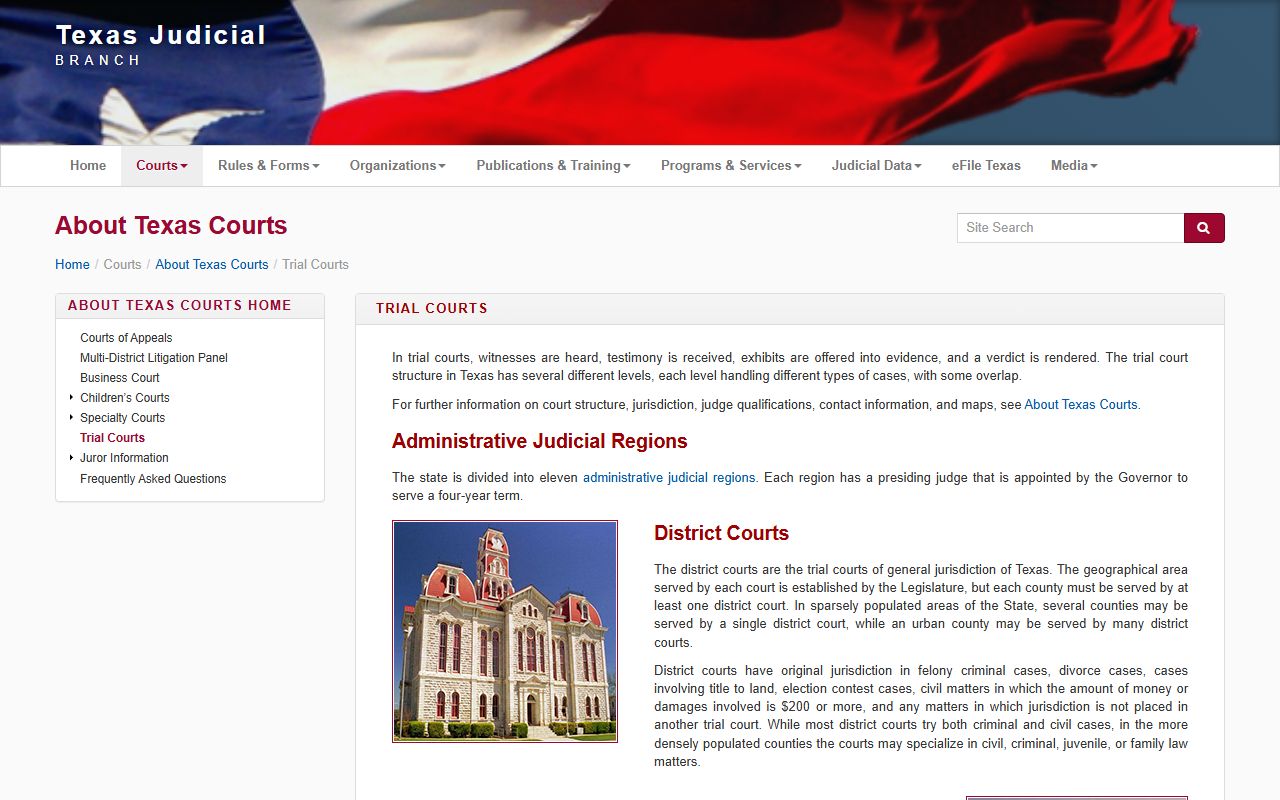
Use the table to match a case type to the court that hears it before you pick a search tool.
| Court | Jurisdiction | Case Types |
|---|---|---|
| District Courts | Primary trial court | Felonies, large civil suits, divorce, family law |
| County Courts at Law | County-level trial court | Class A and B misdemeanors, smaller civil suits |
| County Court / Probate | Estate and welfare matters | Probate, guardianship, mental health commitments |
| Justice of the Peace | Precinct court | Small claims up to $20,000, evictions, fine-only tickets |
Jefferson County Courthouses
Most court work happens at the Jefferson County Courthouse in downtown Beaumont on Pearl Street. The County Clerk and District Clerk both keep offices there, and the district and county courts use the same complex. Some civil and family courts list 1149 Pearl Street while the clerks and several criminal courts list 1085 Pearl Street, so check your notice for the exact entrance. The Port Arthur sub-courthouse serves the south end of the county for clerk and justice-court business.
The County Clerk homepage, shown below, lists both the Beaumont and Port Arthur offices and links the online tools you can read more about at the Jefferson County official site.
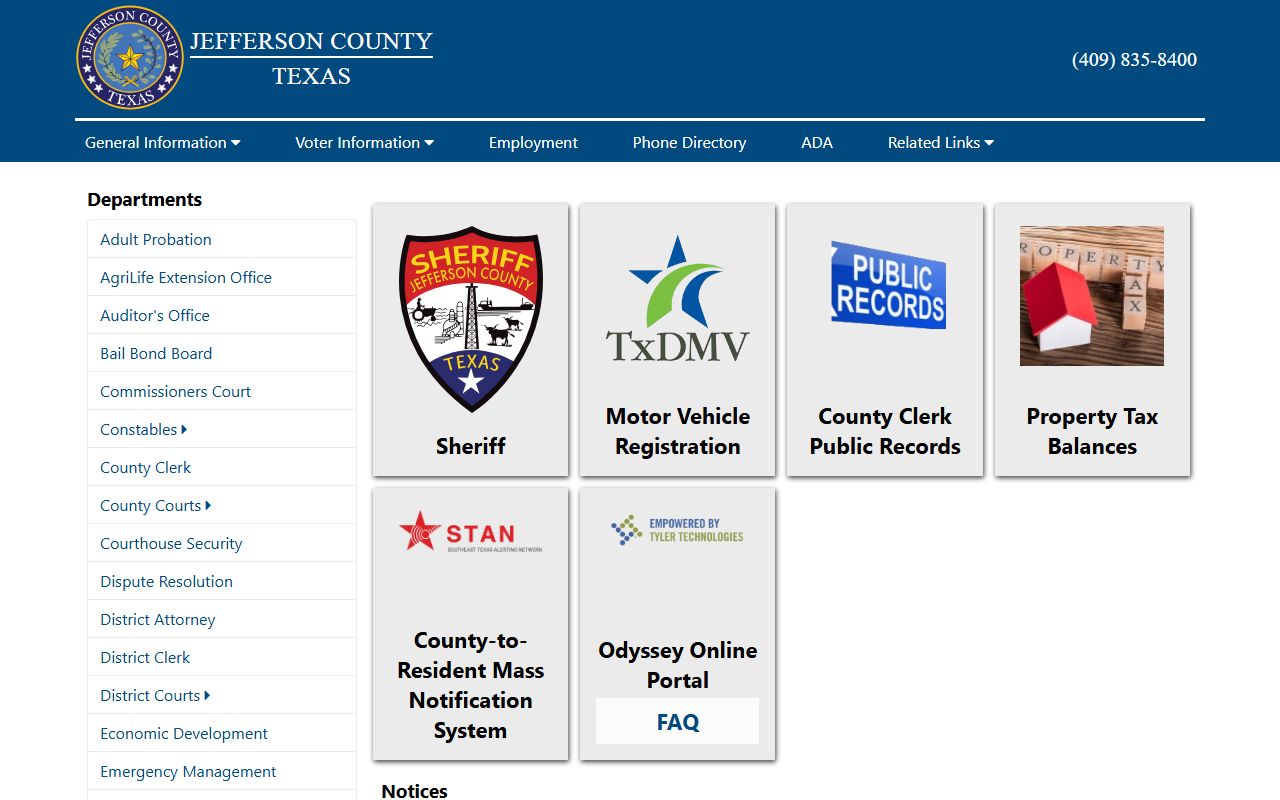
Both addresses below are downtown service points for filing, copies, and in-person help.
Jefferson County Courthouse (Beaumont)
1085 Pearl Street
Beaumont, TX 77701
409-835-8400
District Clerk (Room 203)
1085 Pearl Street, Room 203
Beaumont, TX 77701
409-835-8580
Port Arthur Sub-Courthouse
525 Lakeshore Drive
Port Arthur, TX 77640
409-983-8340
Types of Court Records Available in Jefferson County
Jefferson County court records cover a wide range of cases. The right index depends on the kind of record. District courts produce felony, large civil, and family files. County Courts at Law produce misdemeanor and small civil files. The County Clerk holds probate, marriage, and official public records. Each record series has its own online coverage and its own copy rules.
The list below groups the main record types and points to where each one lives.
- Criminal records - felony files at the District Clerk; Class A and B misdemeanors at the County Clerk.
- Civil records - large suits in district court; smaller suits in County Court at Law No. 1.
- Family and divorce records - filed with the District Clerk and heard in family district courts.
- Probate records - estates, guardianships, and mental health cases through the County Clerk.
- Traffic court records - fine-only tickets in justice and municipal courts; DWI in county criminal courts.
What Jefferson County Court Records Show
A court record is more than a name. Each file and docket holds fields that tell the story of the case. Case numbers in Jefferson County often carry a year and a court code, such as 25DCCV for a district civil suit or 25CCCR for a county criminal case. Dockets list the hearing date, the type of setting, and the attorneys. Full files add pleadings, motions, orders, and the final judgment.
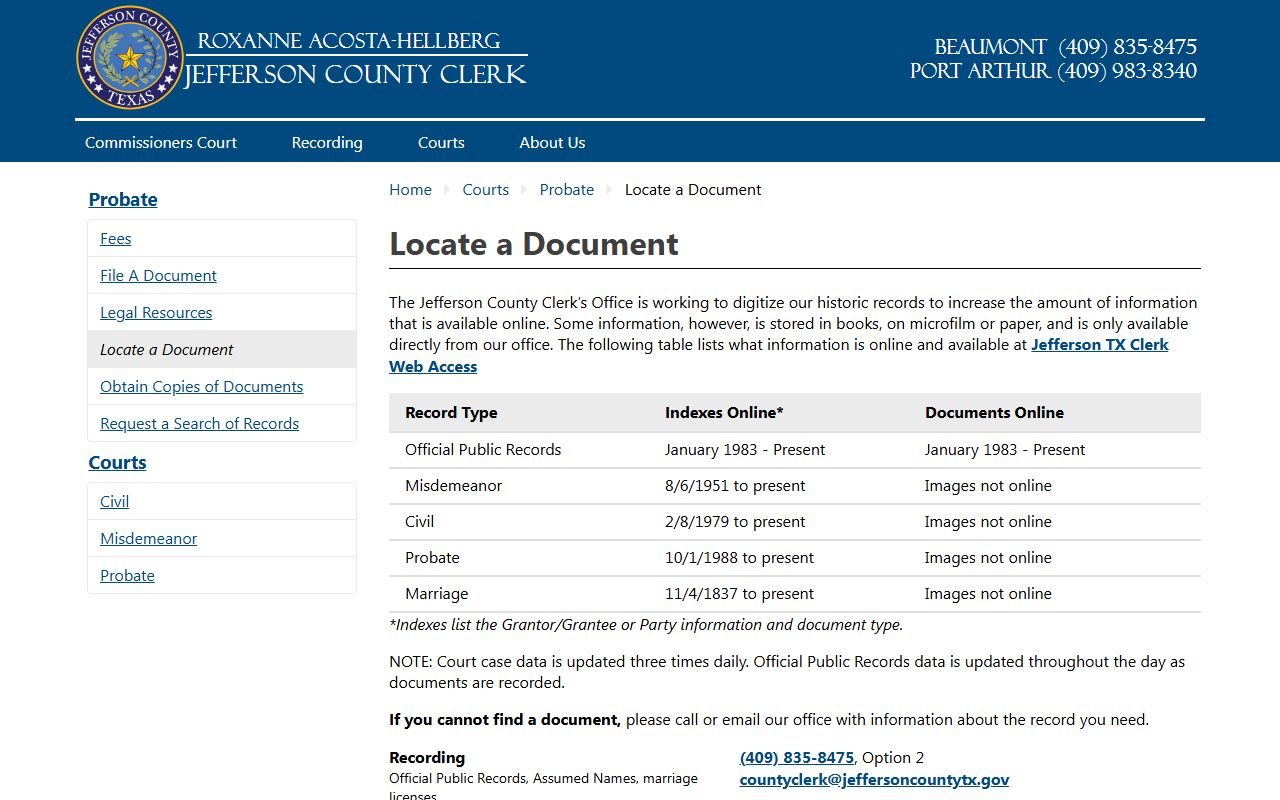
The County Clerk explains its online coverage on a "Locate a Document" page, shown below and linked at the County Clerk locate-a-document page.
The table breaks down the common fields you will see in a Jefferson County court record.
| Field | What It Shows |
|---|---|
| Case Number | Year plus court code, such as 25DCCR for district criminal |
| Filing Date | Date the case was opened with the clerk |
| Parties | Plaintiff and defendant, or the State and a defendant |
| Charges / Cause | The crime charged or the civil claim raised |
| Disposition | Outcome, such as dismissed, disposed, or pending |
| Sentence / Judgment | The court's final ruling or punishment |
Note: County Clerk court case data is updated three times a day, while official public records data updates throughout the day as documents are recorded.
Public Access Laws for Jefferson County Court Records
Texas law leans toward open government, but court files follow their own rules. The Public Information Act covers most county and sheriff records. Court case files are shaped by court rules, common-law access, and sealing orders instead. That is why the District Clerk can post free indexes and still leave sealed and juvenile cases out of public view. Personal data like Social Security numbers is redacted before release.
A few statutes drive how Jefferson County handles access, copies, and record clearing.
Key Statutes:
Texas Government Code § 552 - the Public Information Act, which opens most government records unless a law allows withholding.
Texas Code of Criminal Procedure § 55 - expunction, which lets eligible people have certain criminal records destroyed.
Texas Government Code § 411 - orders of nondisclosure, which limit who can see certain criminal history.
Records That Are Restricted or Confidential
Not every case is open. Jefferson County District Clerk index pages state plainly that cases with any security, including sealed and juvenile matters, are left out. Adoption files are confidential. Mental health commitments heard through the County Court are protected. Grand jury material stays secret. Search warrant affidavits may be sealed while an investigation is active. These limits exist to protect children, victims, and ongoing cases.
To view a sealed civil record, a person usually must ask the court to unseal it, and a judge weighs the request under Texas court rules. For criminal records, expunction destroys eligible files while nondisclosure only hides them from the public. The County Clerk points people to state forms for nondisclosure and suggests legal help for either path.
Specialty Courts in Jefferson County
Jefferson County runs problem-solving programs alongside its regular dockets. The county homepage lists a Drug Impact Court under its district courts. The Community Supervision and Corrections Department, or CSCD, serves that court along with the 252nd, 279th, 317th, County Courts at Law Nos. 2 and 3, and the Criminal District Court. CSCD prepares pre-sentence reports, supervises people on community supervision, and reports back to the courts.
Justice of the Peace Precinct 7 also lists a Youth Diversion program, aimed at young people in lower-level cases. These programs try to cut repeat offenses by mixing supervision, treatment, and court review instead of jail alone.
Jefferson County Sheriff and Jail
The Jefferson County Sheriff's Office, led by Sheriff Zena Stephens, runs the county jail and posts a public inmate search. The Jefferson County Correctional Facility is certified by the Texas Commission on Jail Standards and serves a daily average population of over 800 people. Every person enters and leaves through the Intake and Releases section, which handles identification, classification, and timely release.
For the full roster and field-by-field detail, see Jefferson County inmate records, and for active warrants see warrant records. The roster warns that bond and fees must be paid with exact cash and lists a details line for questions.
Marriage, Divorce, and Probate Records
The County Clerk issues marriage licenses and keeps marriage records that go back to 1837. Divorce is a family matter filed with the District Clerk and heard in district court. Probate, guardianship, and mental health cases run through the County Court. For full steps and fees, see marriage and divorce records and probate records.
A few probate terms come up often. The short list below defines them in plain words.
- Testator
- The person who made a will.
- Executor
- The person named to carry out a will.
- Guardian
- A person the court appoints to care for someone who cannot care for themselves.
Jefferson County Court Records Fees
Most online index searches are free. Copies cost money. The County Clerk charges per page and adds a fee when you need a certified copy that holds up in court. Cloud Search lets you download unofficial, watermarked images at no cost after a free sign-up. Certified copies need clerk approval first.
| Item | Amount |
|---|---|
| Unofficial watermarked image (Cloud Search) | Free after registration |
| Non-certified official copy per page | $1.00 |
| Certification fee | $5.00 |
| Federal tax lien search | $15.00 |
How to Read a Jefferson County Court Record
Court paperwork uses shorthand. An arrest is not a conviction. A charge is only the claim that someone broke the law, while a conviction is a finding of guilt. A docket entry marked DWOP means dismissed for want of prosecution. A disposition is the outcome of a charge or case. Degree codes on the jail roster, such as F1, F2, F3, MA, and MB, mark how serious a charge is, from a first-degree felony down to a Class B misdemeanor.
Bond terms also matter. A surety bond runs through a licensed bondsman. A personal recognizance bond lets a person go on a promise to appear. A capias is an order to take a person into custody, often after a missed court date.
Accuracy and Record Limitations
Online records lag real life. The District Clerk index pages post the date they were built and the date of their data, so a new case may not show yet. County Clerk court data refreshes three times a day. A sealed or corrected file may drop out of a public list. Always confirm a key fact with the office that holds the record before you rely on it.
Note: Confirm names, dates, and case status with the District Clerk or County Clerk before you act, since online indexes can lag or omit secured cases.
History of Jefferson County Courts
Jefferson County's record trail runs deep. The County Clerk's marriage index reaches back to November 4, 1837. Misdemeanor indexes start in 1951, civil in 1979, probate in 1988, and official public records in 1983. The district bench includes long-standing numbered courts, from the 58th to the 317th, plus a dedicated Criminal District Court. E-filing for attorneys in civil and probate cases became mandatory across Texas in 2014, and the District Clerk rolled out a new postcard jury summons in late 2025.
Frequently Asked Questions
Which clerk handles felony records in Jefferson County?
Felony cases are handled by the District Clerk's Office. Start with the District Clerk criminal index or the Tyler Enterprise Justice portal. The County Clerk's own pages confirm that felony files belong to the District Clerk, while the County Clerk keeps misdemeanor county-criminal cases. For more on the split, see the Jefferson County District Clerk page.
Are Jefferson County court documents online?
Some are. The County Clerk posts official public records images from 1983 to today. Misdemeanor, civil, probate, and marriage indexes are online, but those images are not. The District Clerk posts yearly index pages and docket PDFs, and full district access may need a portal account. See court records for the full breakdown.
How do I find a Jefferson County court date?
For misdemeanor settings, the County Courts at Law Nos. 2 and 3 offer an online docket and settings search, or you can call the misdemeanor courts to verify a date. District courts post trial and hearing dockets as PDFs on each court's page. Dockets are schedules, not full case files. For more, see court dockets.
More on the Jefferson County Court Records FAQ page.